What is industrial painting.
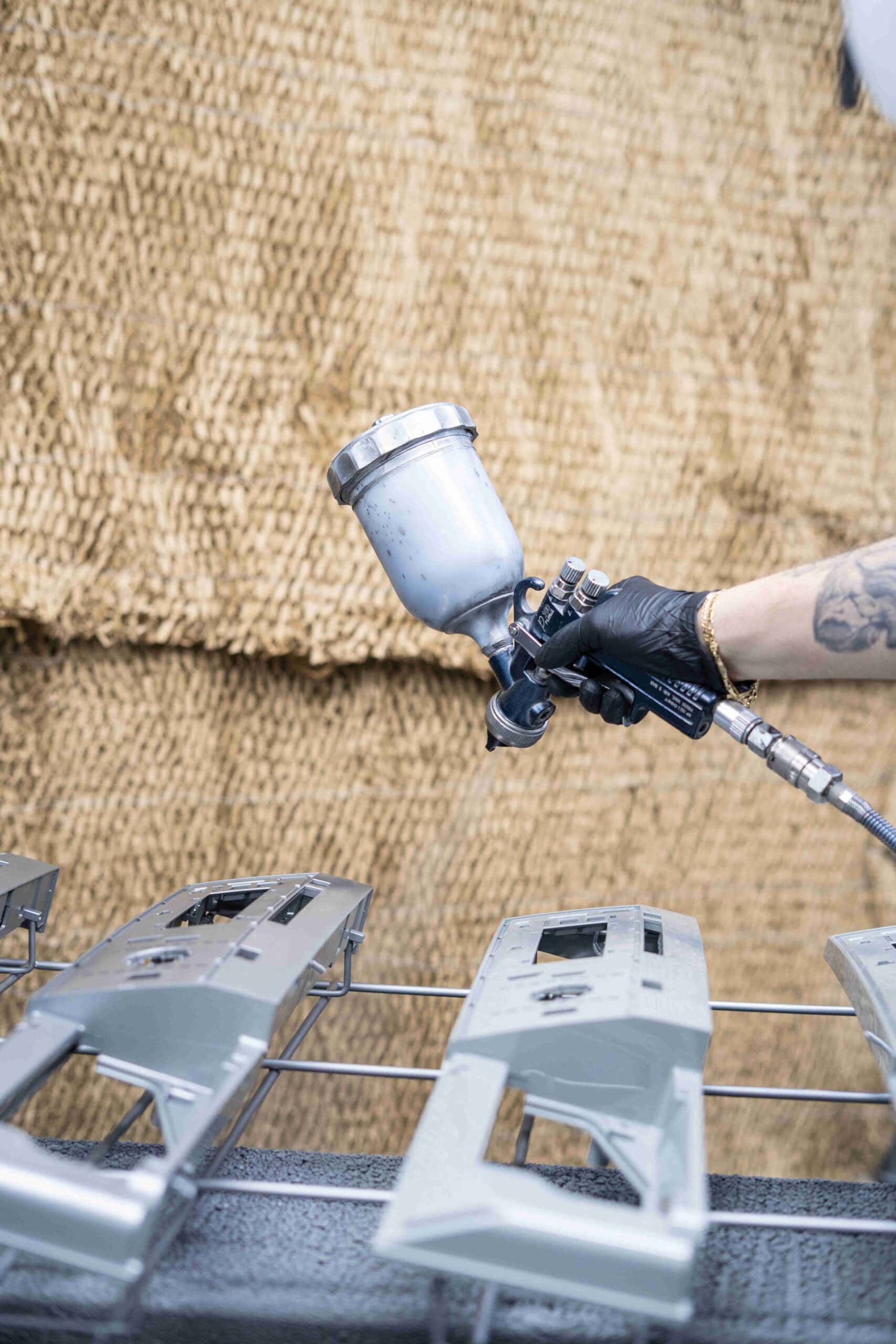
Manual industrial painting is a finishing technique that involves the hand application of paint on industrial components or surfaces. Unlike automated processes, this method allows for direct and precise control by the operator, ensuring high aesthetic and functional quality even on particularly complex or delicate surfaces. The use of manual spray guns makes it possible to adjust the application in real time, based on the shape, material, and specifications of the part being treated. It is the ideal solution for processes that require attention to detail, targeted corrections, or customized finishes, while maintaining high industrial standards.

Areas of application.
Manual painting is widely used in many industries, especially where work on one-off parts, small batches, or components with complex geometries is required. It is extensively applied to automotive parts and household appliances. In the mechanical and metalworking sectors, it is used to coat steel, aluminum, or iron structures such as frames, supports, and panels. It is employed wherever the finish must be precise and carefully executed, often impossible to achieve with automated systems.
Technical advantages.
One of the main advantages of manual industrial spray painting is maximum operational flexibility. The operator can modulate paint quantity and distribution in real time, adapting to every detail of the component. This makes it possible to reach corners, edges, and irregular surfaces that often escape automated machinery. It is ideal for customized work, sampling, prototypes, or small-series production. It allows optimal thickness control, preventing build-up and ensuring uniformity. Immediate visual control enables any imperfections to be corrected during application, reducing waste and rework while improving overall quality.

Our process.
In our industrial painting department, every stage of the work is carried out with artisanal care and industrial rigor. The process begins with thorough surface preparation, which may include cleaning, degreasing, masking, and priming, depending on the material type and the customer’s requirements. We select the most suitable paint—acrylic, polyurethane, epoxy, or water-based—by evaluating the required performance in terms of resistance, adhesion, and aesthetic finish. Application is handled by skilled personnel capable of ensuring uniformity and precision even on complex or delicate parts. At the end of the painting process, each component undergoes rigorous quality control to verify thickness, coverage, finish, and compliance with the required standards.