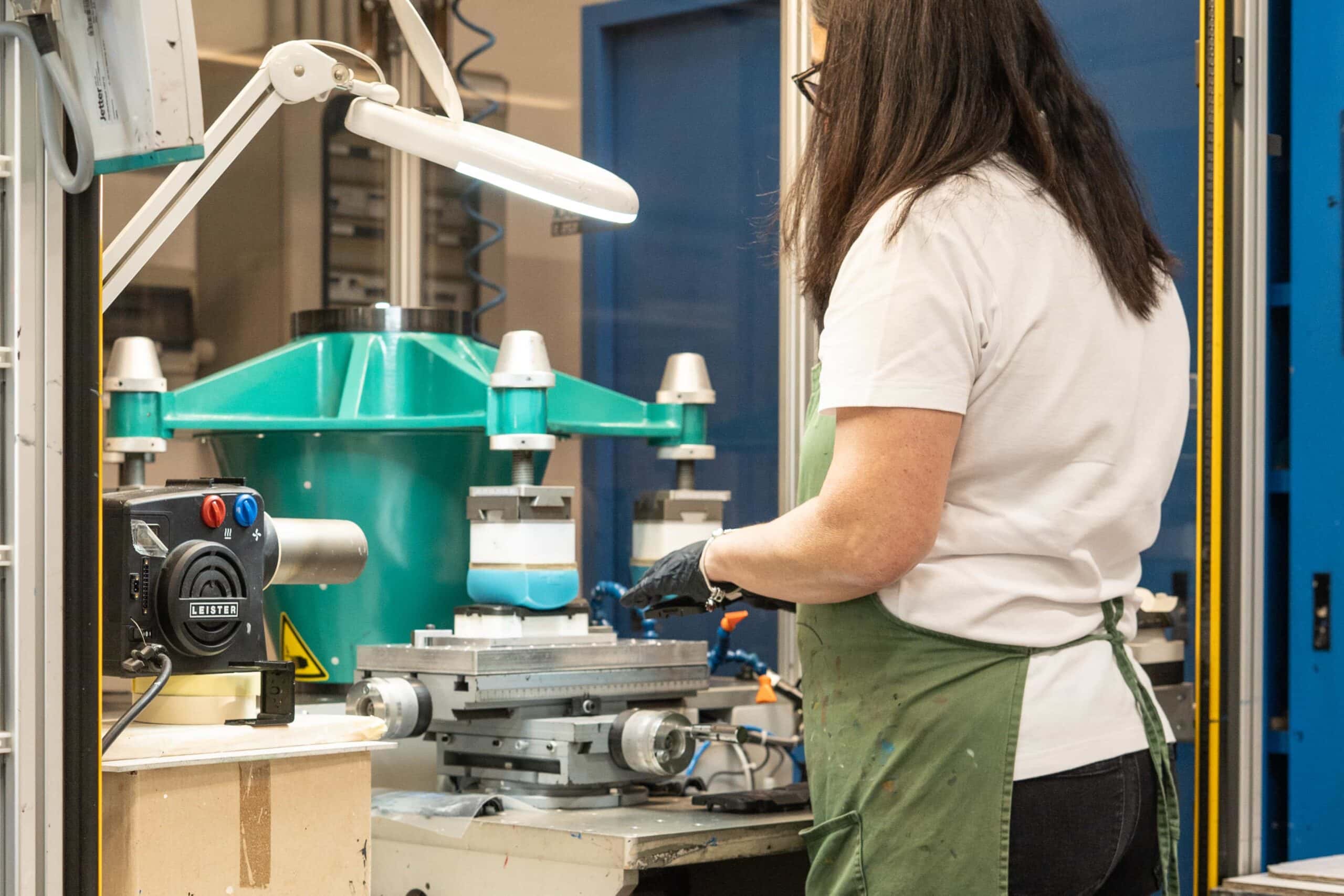
What is pad printing.
Pad printing is an indirect printing technique that is particularly valued for its ability to transfer graphics, text, and logos onto complex surfaces that are difficult to process with other technologies. The process is based on the use of a silicone pad that picks up ink from an engraved plate—known as a cliché—and precisely deposits it onto the product to be printed. Thanks to the flexibility of the pad, it is possible to print on concave, convex, or irregular surfaces while maintaining high quality and perfectly defined details. This characteristic makes industrial pad printing an ideal solution for many applications that require precision, versatility, and long-term durability.

Areas of application.
Pad printing is widely used across a variety of manufacturing sectors, thanks to its ability to adapt to very different materials and shapes. In the electronics industry, it is used for printing on small components, switches, and keyboards. In the automotive sector, it is essential for applying technical graphics and logos on controls, dashboards, and internal or external components. Pad printing on plastic, metal, glass, ceramic, and rubber ensures sharp markings even on challenging surfaces.
Technical advantages.
From a technical standpoint, pad printing offers a unique combination of precision, versatility, and reliability. Its main strength lies in the ability to print on complex surfaces, where traditional methods such as screen printing or digital printing reach their limits. The silicone pad perfectly conforms to the shape of the object, ensuring an even, well-defined print even on small areas or irregular surfaces. It is suitable for numerous materials, including plastic, metal, glass, ceramic, and rubber. In addition, the inks used in pad printing are formulated to provide high adhesion and resistance, even in environments exposed to wear, chemical agents, or temperature variations. Another major advantage is production efficiency: pad printing enables fast cycles and competitive costs even for medium and large production runs, making it highly competitive for industrial applications.

Our process.
In our industrial pad printing department, every project is handled with the utmost care, from the initial design phase through to delivery of the finished product. Our process begins with graphic development and the preparation of the cliché, which is engraved with extreme precision to reproduce the required design. We then select the most suitable ink, taking into account both the substrate material and the conditions of use of the product, to ensure durability, legibility, and color consistency. We use modern machinery and pads of different shapes and hardness levels, allowing us to adapt perfectly to any geometry. The printing phase is followed by rigorous quality control, during which we check every detail: sharpness, alignment, adhesion, and finish. Only after successfully passing these checks is the product packaged and prepared for shipment.